A Misunderstood Flag | The Thirty-Year Instrumentalisation of Ukraine
How Western Formation Politics Built the Conditions for the Ukraine Conflict — and Why It's the Pivot Point of a Collapsing World Order
How Western Formation Politics Built the Conditions for the Ukraine Conflict — and Why It's the Pivot Point of a Collapsing World Order
How Western Formation Politics Built the Conditions for the Ukraine Conflict — and Why It's the Pivot Point of a Collapsing World Order
25 March 2026 - 35 minutes read
Longread by Matteo Martire
Introduction: The Flag You're Waving Is Not What You Think It Is
Across Western cities, the Ukrainian flag has become a moral symbol — a declaration of solidarity with the innocent against the aggressor, democracy against autocracy, the rules-based order against naked barbarism. It adorns social media profiles, government buildings, protest signs. It is, in the vocabulary of our time, a virtue signal par excellence.
The problem is not that Ukraine's people are undeserving of solidarity. They are. The problem is that the flag does not represent Ukraine's people. It represents a geopolitical project — one that was designed, funded, and executed over three decades by Western strategic planners — and whose human cost is now being paid almost entirely by Ukrainians themselves.
This article takes causation seriously. That is what the dominant narrative forbids. The refusal to examine what was built before February 24, 2022 is not solidarity. It is complicity dressed as compassion.
The record does not require interpretation. It requires reading. Declassified cables. On-record admissions. Intercepted communications. The words of Western leaders themselves. What follows is that record — assembled, sourced, and placed in sequence.
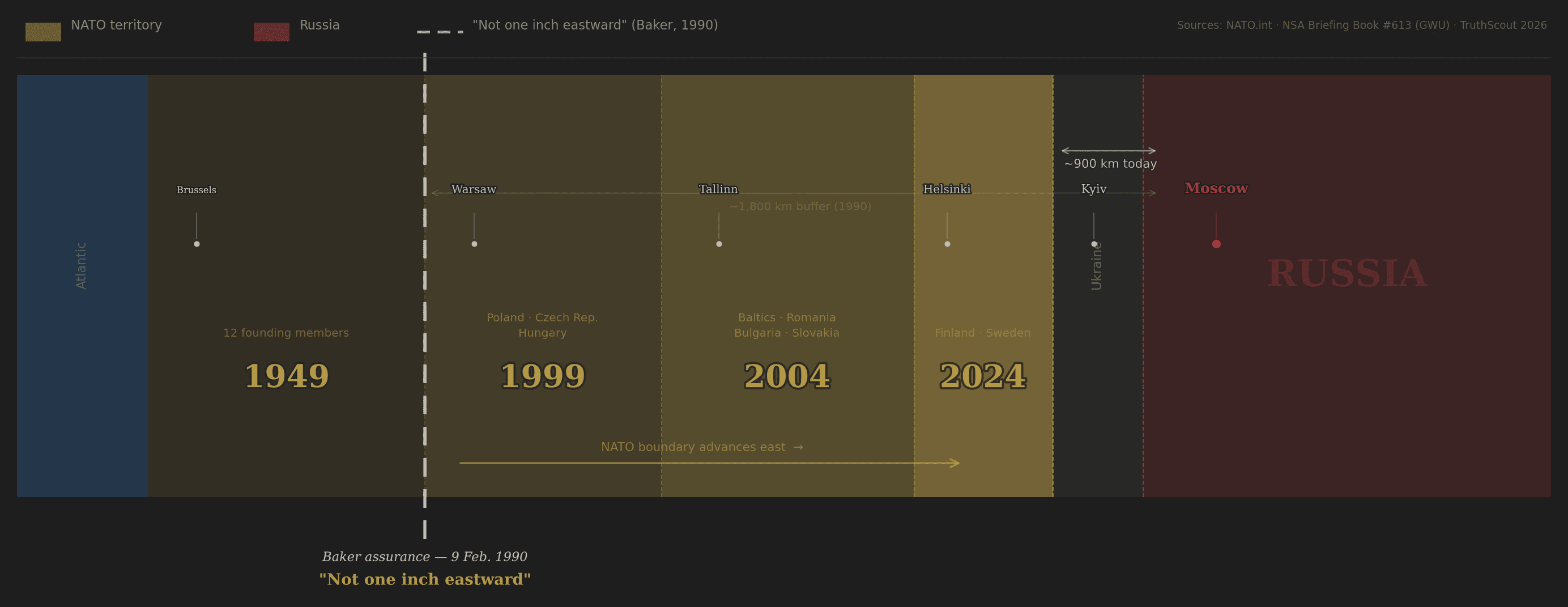
"I think it is the beginning of a new cold war. I think the Russians will gradually react quite adversely and it will affect their policies. I think it is a tragic mistake." — George F. Kennan, architect of US Cold War containment strategy, on NATO expansion — 1997
Source: Baker "not one inch eastward" assurance and cascade of Western promises to Gorbachev, 1990 — declassified documents nsarchive.gwu.edu / primary Baker-Gorbachev memorandum of conversation nsarchive.gwu.edu
"I think it is the beginning of a new cold war. I think the Russians will gradually react quite adversely and it will affect their policies. I think it is a tragic mistake." — George F. Kennan, architect of US Cold War containment strategy, on NATO expansion — 1997
Source: link
Part I: The Promise That Was Made — and Broken
The Baker Assurance, 1990
On February 9, 1990, US Secretary of State James Baker met Soviet leader Mikhail Gorbachev in Moscow. The subject was German reunification. There had never been a formal treaty to end World War II. The Soviet Union — which had lost 27 million people to Hitler's armies — had consistently demanded a demilitarised, neutral Germany as its primary post-war security condition. The United States refused that position and instead chose to rearm Germany within NATO, framing it as a defence against communism rather than a pragmatic guarantee of Soviet security.
In 1990, the price of Soviet acquiescence to German reunification within NATO was explicit: in exchange, Baker told Gorbachev there would be "no extension of NATO's jurisdiction for forces of NATO one inch to the east."
This assurance was not a vague diplomatic pleasantry. It was repeated by Baker, by West German Foreign Minister Hans-Dietrich Genscher, by Chancellor Helmut Kohl, and by British Foreign Secretary Douglas Hurd — all in the weeks surrounding German reunification. The National Security Archive at George Washington University published the relevant declassified documents in December 2017. The primary Baker-Gorbachev memorandum of conversation, confirming the "not one inch" language verbatim, is publicly accessible.
[NSA Briefing Book #613, December 12, 2017: nsarchive.gwu.edu]
[Baker-Gorbachev memorandum of conversation, February 9, 1990: nsarchive.gwu.edu]
Mikhail Gorbachev — a man who ended the Cold War, dissolved the Warsaw Pact unilaterally, and trusted that his Western counterparts would honour their commitments — agreed. He is remembered in Russia primarily for the collapse of the Soviet Union and for inflation. He deserves to be remembered as the statesman who made the peaceful end of the Cold War possible, and who was subsequently cheated by every party he trusted. The Soviet Union dissolved in December 1991. Within three years, the assurances were being actively dismantled.
Clinton Signs Off: 1994
In January 1994, President Bill Clinton formally announced NATO enlargement to the east. The decision — formalised through the Partnership for Peace framework and then accelerated through the 1995 Study on NATO Enlargement — explicitly identified former Warsaw Pact states, and ultimately Ukraine and Georgia, as candidates for membership.
George Kennan, writing in the New York Times in February 1997, described this as the "most fateful error of American policy in the entire post-cold-war era." He predicted it would "inflame the nationalistic, anti-Western and militaristic tendencies in Russian opinion," restore the atmosphere of the cold war, and "impel Russian foreign policy in directions decidedly not to our liking." He was predicting, with precision, exactly what came to pass — twenty-five years before it did.
Kennan was the intellectual architect of the entire post-war Western strategic order. When he said this was a catastrophic mistake, he was speaking from inside the house. Official Washington ignored him.
[George Kennan, "A Fateful Error," New York Times, February 5, 1997: midcoastseniorcollege.org]
The 1999 Expansion and Belgrade: Russia's First Warning
NATO's first formal eastward expansion came in March 1999: Poland, Hungary, and the Czech Republic. That same month — March 24, 1999 — NATO began a 78-day bombing campaign against the Federal Republic of Yugoslavia. Belgrade, a European capital, was bombed continuously. Serbian civilian infrastructure was destroyed. Kosovo was forcibly separated from Serbia in an operation with no UN Security Council authorisation.
The message delivered to Moscow was precise: NATO was not a defensive alliance constrained by international law. It was an instrument of Western strategic will, deployable against any state that defied the emerging unipolar order. Russia had proposed diplomatic alternatives. Russia was ignored.
[Putin Munich Security Conference speech, February 10, 2007: en.kremlin.ru]
2002: The ABM Treaty and the Nuclear Destabilisation
In December 2002, the United States unilaterally withdrew from the Anti-Ballistic Missile Treaty — the foundational arms control agreement that had maintained nuclear deterrence stability since 1972. The withdrawal was not a response to any Russian provocation. It was a unilateral strategic choice.
What followed was the deployment of Aegis missile systems in Poland and then in Romania — systems that Russia identified as capable of being reconfigured to fire offensive Tomahawk cruise missiles, thereby potentially enabling a decapitation strike on Russian command infrastructure within minutes of launch. For Moscow, this was not a theoretical concern. It was a direct alteration of the strategic nuclear balance, combined with the simultaneous advance of NATO's conventional military infrastructure toward Russia's border.
The combination of conventional expansion and nuclear framework destabilisation, running simultaneously through the 2000s, is what gives the Russian security argument its structural coherence. This was not one provocation. It was a sustained, layered degradation of every security framework that had governed the post-Cold War relationship.
2004: NATO Arrives at Russia's Border
The second major expansion came in March 2004. Seven countries joined simultaneously: Bulgaria, Estonia, Latvia, Lithuania, Romania, Slovakia, and Slovenia. The three Baltic states brought NATO's military infrastructure to within 150 kilometres of St. Petersburg, Russia's second city.
John Mearsheimer, Professor of Political Science at the University of Chicago, had been warning since the early 1990s that this trajectory would end in catastrophe. His 2014 Foreign Affairs piece made the structural argument precisely: no major power tolerates military alliance infrastructure on its border, and the United States would respond identically — within minutes — to any comparable Russian expansion toward its own perimeter. This prediction was made twenty years before the invasion. It was ignored because it was inconvenient.
[Mearsheimer, "Why the Ukraine Crisis Is the West's Fault," Foreign Affairs, September/October 2014: foreignaffairs.com]
Part II: Russia, Ukraine, and the History That Makes This Worse
The Counter-Argument: "Putin Wants the Soviet Union Back"
Before going further, the most common objection must be addressed directly — because it is not entirely without basis, and because its partial truth is being used to foreclose the more important structural argument.
The objection: Vladimir Putin published a 5,000-word essay in July 2021, "On the Historical Unity of Russians and Ukrainians," arguing that Russians and Ukrainians are fundamentally one people — sharing a civilisational origin, a spiritual heritage, and a common history artificially severed by Western manipulation. He questioned the legitimacy of Ukraine's post-Soviet borders. The Carnegie Endowment described it as "a historical, political, and security predicate for invading Ukraine." Former Estonian President Toomas Hendrik Ilves compared it to Hitler's 1938 rhetoric on the Sudetenland.
[Putin, "On the Historical Unity of Russians and Ukrainians," Kremlin, July 12 2021: en.kremlin.ru]
State the concession plainly: Putin has imperial instincts. The essay is real. The historical claims in it are selectively assembled in service of a political argument. None of this is in dispute.
Now state what this concession does not establish — and why the objection, taken seriously, deepens the indictment of Western strategy rather than weakening it.
The History Is Real — And That Is Precisely the Problem
The shared civilisational history between Russia and Ukraine is not a Putin invention. Kyiv — the capital of modern Ukraine — was the founding city of Kievan Rus, the medieval state from which both Russian and Ukrainian national identities descend. Orthodox Christianity, the defining spiritual framework of Russian civilisation, was adopted in Kyiv in 988 AD. The first textbook of Russian history was written in Kyiv in the 1670s. The Moscow Patriarchate traces its ecclesiastical lineage directly to Kyiv.
This is not contested by serious historians. It is the starting point of the dispute — because both Russian and Ukrainian national identity claim this inheritance, and the question of which people it belongs to is itself a live political battleground.
The subsequent centuries — Ottoman pressure from the south, Polish-Lithuanian dominance of western Ukraine from the 15th century, the incorporation of left-bank Ukraine into the Russian Empire in 1654, the absorption of right-bank Ukraine through the partitions of Poland in the late 18th century, the Soviet construction of a Ukrainian SSR with borders incorporating predominantly Russian-speaking eastern territories — produced a country whose eastern and western halves had been shaped by genuinely different historical experiences.
By 1991, Ukraine contained: a predominantly Ukrainian-speaking, historically Catholic west shaped by Habsburg and Polish influence; a predominantly Russian-speaking, historically Orthodox east shaped by Russian imperial integration; Crimea — transferred from Russia to Ukraine by Soviet administrative decision in 1954, with a population that was 65% ethnically Russian; and a capital sitting roughly at the cultural fault line between these two orientations.
This complexity is genuine. And it is the single most important fact for understanding what follows — because a state with this precise historical structure is the last place on Earth a rational actor should run a NATO expansion operation through.
Unless, of course, that complexity was the point.
Brzezinski Tells You Exactly Why Ukraine Was Chosen
In 1997, Zbigniew Brzezinski — National Security Advisor to President Carter, architect of America's Cold War strategy in Central Asia, the most influential US geostrategist of the 20th century — published The Grand Chessboard: American Primacy and Its Geostrategic Imperatives. This was not a classified document. It was a mainstream academic text, reviewed in Foreign Affairs, praised by the German Foreign Minister in its foreword. It laid out explicitly what American grand strategy in Eurasia should look like for the coming generation.
On Ukraine, Brzezinski was precise:
"Ukraine, a new and important space on the Eurasian chessboard, is a geopolitical pivot because its very existence as an independent country helps to transform Russia. Without Ukraine, Russia ceases to be a Eurasian empire."
And further:
"However, if Moscow regains control over Ukraine, with its 52 million people and major resources as well as access to the Black Sea, Russia automatically again regains the wherewithal to become a powerful imperial state, spanning Europe and Asia."
And on the overall objective:
"It is imperative that no Eurasian challenger emerges, capable of dominating Eurasia and thus also of challenging America."
[Brzezinski, The Grand Chessboard, 1997 — full text hosted on CIA.gov: cia.gov]
Read that again with the preceding section in mind. Brzezinski is not describing Ukraine's NATO membership as an incidental democratic outcome. He is identifying Ukraine as the single most important geopolitical lever for preventing Russia from reconstituting as a Eurasian great power. He is saying, in plain language, that the orientation of Ukraine is the mechanism by which American primacy in Eurasia is either preserved or lost.
This book was published in 1997. The NED was already operating in Ukraine. The Partnership for Peace was already running. Brzezinski was not reacting to events. He was describing a strategic objective already being pursued — and providing its intellectual justification in advance.
The "Putin wants Ukraine back" argument collapses on contact with The Grand Chessboard. Of course Ukraine has historical and strategic significance to Russia. That is precisely why it was chosen as the primary expansion front. American strategists understood exactly what they were doing. They selected the territory most entangled with Russian identity, most culturally divided, most sensitive to Moscow's security calculations — and ran their most aggressive expansion operation directly through it. The historical complexity was not an obstacle. It was the instrument.
The Baltic States Pattern: Empire or Containment?
The empirical test of whether Putin's motivation is imperial reconstitution or security containment is the observable pattern of where he actually moved — and where he did not.
Estonia, Latvia, and Lithuania joined NATO in March 2004. All three are former Soviet republics. All three have significant Russian-speaking minority populations. All three border Russian territory directly. If Putin's motivation were Soviet reconstitution, these are obvious first targets. He did not move against them. In twenty-one years since their accession, no military action.
Poland, Romania, Bulgaria, Slovakia, Slovenia — all former Warsaw Pact states, now NATO members. No military action.
Putin moved militarily in three specific cases: Georgia in 2008, when NATO formally signalled that Georgia would eventually receive membership at the Bucharest summit; Crimea in 2014, following the Western-backed removal of the neutrality-oriented Yanukovych government; Ukraine in 2022, following the December 2021 rejection of his security treaty proposals and the continued acceleration of Ukrainian NATO integration.
The pattern is unambiguous. Putin moved in precise correlation with the most acute NATO expansion pressures — not in correlation with the existence of former Soviet territory or Russian-speaking populations as such.
An empire reconstructor expands wherever opportunity allows. A security-maximiser responds to specific provocation at specific pressure points. The empirical record is consistent with the second model and inconsistent with the first.
This does not make Putin's conduct legitimate or proportionate. It makes the standard Western framing — "unprovoked aggression by a man who wants the Soviet Union back" — analytically false. And analytical falseness in the framing of a war that has killed hundreds of thousands of people is not an academic problem. It is the mechanism by which the architects of the conditions that produced the war escape accountability for what they built.
The Deeper Implication: Weaponising History Against Its Inhabitants
The genuine historical complexity of Ukraine — the Kievan Rus inheritance, the east-west cultural fault line, the Russian-speaking east, the Habsburg-influenced west — did not by itself create the conditions for this war. That complexity existed for centuries without producing a conflict of this scale. What converted it into a collision was the deliberate decision to run a strategic expansion operation through the most historically contested, most culturally divided, most geopolitically sensitive state in the entire post-Soviet space.
Brzezinski told you why: because that complexity is what makes Ukraine the decisive lever. A homogeneous, stable Ukraine with a settled national identity would be strategically less valuable. A divided, contested, historically entangled Ukraine — pulled simultaneously by its Russian-speaking east and its Western-oriented west, sitting precisely on the fault line between NATO's expansion ambitions and Russia's security red lines — is the maximum pressure point. Its very instability is its strategic utility.
The people who designed this strategy understood Ukrainian history better than most Ukrainians were permitted to discuss it publicly. They chose this territory not despite its complexity but because of it.
The flag that well-meaning Westerners display on their social media profiles is the symbol of a country whose historical complexity was identified thirty years ago as the optimal instrument for degrading Russian great power capacity — by the man whose ideas became the blueprint for American Eurasian strategy. The people waving the flag do not know this. The people who designed the strategy did.
That is the full weight of what instrumentalisation means.
Part III: The Formation of Ukraine — How a Country Gets Built Into a War
The First Colour Revolution: 2004
The 2004 Ukrainian presidential election produced a contested result. What followed — the "Orange Revolution" — brought Viktor Yushchenko to power. Western involvement in supporting his campaign has been extensively documented: the National Endowment for Democracy, a US government-funded body whose explicit purpose is political influence promotion abroad, had been operating in Ukraine since the early 1990s, channelling tens of millions of dollars to pro-Western civil society groups, media outlets, and political organisations.
The Guardian's Ian Traynor documented the operation in detail on November 26, 2004 — including the network of US-funded NGOs, the role of Serbian trainers from Otpor (themselves trained and funded by the US), and the overall architecture of what he called "an American creation."
[Ian Traynor, "US campaign behind the turmoil in Kiev," The Guardian, November 26, 2004: theguardian.com]
The key point is not whether Yushchenko was undemocratic or whether the electoral fraud wasn't real. The key point is this: a US-backed candidate winning a contested election in a neighbouring state of Russia, on an explicitly NATO-integration platform, engineered through a US-funded operation, is not organic democracy. It is strategic formation dressed as democracy promotion.
It is also worth naming what this represents in terms of imperial logic. The United States, as Jeffrey Sachs has observed, does not accept neutrality as a viable political position. Neutrality — the very outcome Ukrainian voters had repeatedly demonstrated they preferred — is treated by Washington as a defection from the Western order. "You're either with us or you're against us" is not rhetoric. It is operational policy. A neutral Ukraine was always the one outcome the formation process was designed to prevent.
Yanukovych Wins on Neutrality: 2010
In 2010, Viktor Yanukovych ran again. This time the election was not contested. International observers including the OSCE declared it free and fair. Yanukovych won on a platform of Ukrainian neutrality — neither NATO membership nor formal alignment with Russia. This reflected the genuine preferences of much of Ukraine's population, particularly in the east and south.
This data point is almost entirely absent from Western coverage of the conflict. In a free and fair election, the Ukrainian people chose neutrality. They did not choose NATO.
[OSCE/ODIHR Election Observation Mission, Final Report, Ukrainian Presidential Election 2010: osce.org]
Russia's core demand — stated from 2007 onwards, formalised in Putin's December 2021 draft security treaty — was never Ukrainian subjugation. It was Ukrainian neutrality. Which is precisely what Ukrainian democracy had just produced. The distance between what Russia wanted and what Ukrainians had voted for was, at that moment, essentially zero. Western policy spent the next four years eliminating that alignment.
The 2014 Coup: Manufacturing the Break Point
On February 22, 2014, Viktor Yanukovych was removed from power following weeks of violent protest on Kyiv's Maidan. The catalyst was Yanukovych's suspension of an EU Association Agreement — taken after Russia offered Ukraine a $15 billion loan package as an alternative. The protests were real. Popular discontent with a corrupt government was genuine. What followed was not.
The Nuland-Pyatt Call — February 4, 2014
Three weeks before Yanukovych's removal, a phone call between Victoria Nuland — US Assistant Secretary of State for European and Eurasian Affairs — and Geoffrey Pyatt, US Ambassador to Ukraine, was intercepted and published. Its authenticity was confirmed by State Department spokeswoman Jen Psaki.
In the call, Nuland and Pyatt discussed which Ukrainian political figures should fill positions in the post-Yanukovych government. Nuland expressed explicit preference for Arseniy Yatsenyuk as Prime Minister. She dismissed EU diplomatic involvement with the phrase "Fuck the EU." Pyatt discussed how to "midwife" the transition.
Yatsenyuk became Prime Minister twenty-one days later.
This is a senior US official, on record, selecting a foreign government before the sitting government had fallen. The Washington Post, NPR, France 24, and the Atlantic Council all confirmed the call's authenticity.
[Full transcript with BBC commentary: globalresearch.ca]
[Washington Post confirmation: washingtonpost.com]
The Donbas: The War That Precedes the War
Following the 2014 government change, Ukraine's new administration moved against the Russian-speaking population of eastern Ukraine. From 2014 to 2022 — eight years — the Ukrainian military and associated paramilitary formations, including the Azov battalion (documented by Amnesty International for unlawful killings, later incorporated into the National Guard), conducted operations resulting in over 14,000 deaths, the displacement of over 1.5 million people, and sustained artillery bombardment of civilian areas.
This eight-year conflict is largely absent from Western media framing of the Ukraine war, which dates the conflict to February 24, 2022. The omission is structural: if the Donbas exists in the account, the narrative of unprovoked Russian aggression against a peaceful country becomes unsustainable.
[OSCE Special Monitoring Mission to Ukraine — reports 2014-2022: osce.org]
[Amnesty International, "Unlawful and Lethal," 2014-2015: amnesty.org]
Minsk II: The Agreement Designed Not to Be Kept
In February 2015, Germany, France, Ukraine, and Russia signed the Minsk II agreement. It called for a ceasefire, withdrawal of heavy weapons, and constitutional reform granting autonomy to the Donetsk and Lugansk regions. The UN Security Council endorsed it unanimously via Resolution 2202, making it binding under international law. Ukraine signed it. Its parliament ratified it. It was never implemented.
In December 2022, Angela Merkel told Die Zeit with striking candour: "The 2014 Minsk agreement was an attempt to give Ukraine time. It also used this time to become stronger, as you can see today." Former French President François Hollande made near-identical remarks the same month. Ukrainian President Poroshenko had said the same to domestic audiences in 2015.
Two principal Western guarantors of an internationally binding UN Security Council-endorsed peace agreement have publicly confirmed on the record that the agreement was not made in good faith. It was strategic delay. Russia signed a peace agreement with parties who had already decided they would not honour it.
[Merkel Die Zeit interview, December 7, 2022 — TASS report: tass.com]
[UN Security Council Resolution 2202 (2015): documents.un.org]
Part IV: The Formation Is Complete — Then Used as Justification
What Thirty Years of Cultivation Produces
By 2022, Ukraine's institutional landscape had been systematically shaped across three decades: its political class cultivated through Western-funded programmes and leadership academies; its military retrained and re-equipped to NATO standards through bilateral US, UK, and Canadian programmes since 2015; its media environment reshaped through USAID and NED-linked bodies; its educational institutions subject to systematic Westernisation.
The resulting Ukrainian public preference for NATO integration was real. It was also, in significant part, the output of a thirty-year formation process — institutional, cultural, financial, and political — funded and directed by Western governments and foundations.
This is not a denial of Ukrainian agency. It is the observation that agency and conditioning are not mutually exclusive. The preferences were genuine. The process that produced them was engineered. And once the preferences existed, they were used as justification for the formation itself — a closed recursive loop. The child didn't choose to become what it became in a vacuum. It was built into it. Then what it became was deployed as cover for what built it.
December 2021: The Last Exit
On December 17, 2021, Russia submitted a formal draft security treaty to the United States and NATO. The core demand: no further NATO enlargement, and no deployment of offensive weapons systems in countries bordering Russia.
The US response, delivered by Blinken to Lavrov in January 2022: the United States reserved the right to place military systems wherever it chose. Non-negotiable.
[Russia's December 2021 draft security treaty: mid.ru]
On February 24, 2022, Russia invaded.
Istanbul: The Peace That Wasn't Allowed to Happen
Five days after the invasion, Zelensky's government signalled willingness to negotiate on neutrality. By March 2022, talks in Istanbul had produced a tentative framework — Ukrainian neutrality, security guarantees from third parties, a ceasefire — described by both delegations as near-agreement.
In April 2022, Boris Johnson flew unannounced to Kyiv. Davyd Arakhamia — head of the Ukrainian negotiating delegation — stated in a November 2023 television interview that Johnson had conveyed: the collective West would not support an agreement, and Ukraine should "not sign anything with them at all — let's just fight."
Three days after Johnson's departure, Putin publicly stated the talks had "turned into a dead end."
[Arakhamia interview — Daily Sabah report: dailysabah.com]
[Academic analysis of Istanbul talks — H-Diplo/RJISSF: issforum.org]
The war that has since killed an estimated 600,000–1,000,000 people — the majority Ukrainian — continued because the parties with the most leverage to support a settlement decided that fighting on served their strategic interests better than peace.
Part V: The Capital Architecture of Continuation
The question of who caused the Ukraine war is a question about the past. The question of who profits from its continuation is a question about the present. The answer to the second is structurally independent of the answer to the first.
Defense sector: Lockheed Martin's share price rose 37% in the twelve months following the invasion. Raytheon's order book expanded by billions. BAE Systems, Rheinmetall, and General Dynamics recorded historic order growth. BlackRock, Vanguard, and State Street — the Big Three institutional investors — hold dominant stakes across all of them.
Energy sector: European dependence on Russian gas created immediate demand for US LNG exports. The destruction of the Nord Stream pipelines in September 2022 — sabotaged in an operation that Seymour Hersh attributed in exhaustive detail to a US-directed covert programme — permanently redirected European energy demand toward US suppliers. ExxonMobil and Chevron recorded their highest profits in company history in 2022 and 2023.
[Seymour Hersh, "How America Destroyed the Nord Stream Pipeline," Substack, February 8, 2023: seymourhersh.substack.com]
Reconstruction finance: BlackRock was formally contracted by the Ukrainian government in July 2022 to advise on the reconstruction investment framework — positioning the same institutional investor that profits from the weapons that destroy Ukraine's infrastructure to manage the financial architecture of rebuilding it.
[BlackRock Ukraine advisory announcement, July 2022: blackrock.com]
The weapons that destroy, the energy that profits from disruption, and the capital that manages reconstruction: held by the same institutional shareholder networks. This is not conspiracy. It is structural incentive. The war does not require anyone to have planned it for it to produce these returns. It requires only that the people with the most leverage to end it have the most to gain from its extension.
Part VI: The Global South Axis — What Ukraine Actually Reveals
What Russia Actually Represents
Russia is not a virtuous actor. Its conduct of the war — the targeting of civilian infrastructure, the documented deportation of Ukrainian children for which the ICC issued an arrest warrant against Putin in March 2023, the use of prohibited munitions — is criminal under any standard of international humanitarian law.
[ICC arrest warrant for Putin, ICC-01/22, March 17 2023: icc-cpi.int]
State that clearly. Then state this clearly: none of it changes the structural argument. Russia is not the first state to respond to strategic encirclement with disproportionate force. The United States responded to Soviet missiles in Cuba in 1962 with a naval blockade that brought the world to the edge of nuclear war. The principle that a nuclear power does not accept hostile military infrastructure on its border is not Russian exceptionalism. It is the consistent practice of every major power in modern history.
What Russia represents in the current global order is not virtue. It is disruption. It is a major power that has decided it will not accept unipolar Western dominance as the permanent condition of the international system. The consequences of that decision are being paid in Ukrainian blood. The question is who manufactured the conditions that made that collision inevitable.
The Global South Is Watching This Differently
When the UN General Assembly voted to condemn Russia's invasion, the abstentions told a story Western media declined to examine. India abstained. China abstained. South Africa abstained. Brazil abstained. Much of Africa abstained. The countries that abstained collectively represent the majority of the world's population.
Their stated reasons were not pro-Putin. They were explicitly about principle: selective application of international law is not international law. The same Western powers invoking the UN Charter against Russia's violation of Ukrainian sovereignty had violated the sovereignty of Iraq in 2003 without Security Council authorisation. They had bombed Libya into collapse in 2011. They were simultaneously supplying weapons used to kill civilians in Gaza while invoking civilian protection in Kyiv.
The selective moral indignation was visible from the Global South in ways it was not visible from inside it.
[UN General Assembly vote ES-11/1, March 2, 2022: undocs.org]
The Other Flag in the Frame
Part I: The Promise That Was Made — and Broken
The Baker Assurance, 1990
On February 9, 1990, US Secretary of State James Baker met Soviet leader Mikhail Gorbachev in Moscow. The subject was German reunification. There had never been a formal treaty to end World War II. The Soviet Union — which had lost 27 million people to Hitler's armies — had consistently demanded a demilitarised, neutral Germany as its primary post-war security condition. The United States refused that position and instead chose to rearm Germany within NATO, framing it as a defence against communism rather than a pragmatic guarantee of Soviet security.
In 1990, the price of Soviet acquiescence to German reunification within NATO was explicit: in exchange, Baker told Gorbachev there would be "no extension of NATO's jurisdiction for forces of NATO one inch to the east."
This assurance was not a vague diplomatic pleasantry. It was repeated by Baker, by West German Foreign Minister Hans-Dietrich Genscher, by Chancellor Helmut Kohl, and by British Foreign Secretary Douglas Hurd — all in the weeks surrounding German reunification. The National Security Archive at George Washington University published the relevant declassified documents in December 2017. The primary Baker-Gorbachev memorandum of conversation, confirming the "not one inch" language verbatim, is publicly accessible.
[NSA Briefing Book #613, December 12, 2017: nsarchive.gwu.edu]
[Baker-Gorbachev memorandum of conversation, February 9, 1990: nsarchive.gwu.edu]
Mikhail Gorbachev — a man who ended the Cold War, dissolved the Warsaw Pact unilaterally, and trusted that his Western counterparts would honour their commitments — agreed. He is remembered in Russia primarily for the collapse of the Soviet Union and for inflation. He deserves to be remembered as the statesman who made the peaceful end of the Cold War possible, and who was subsequently cheated by every party he trusted. The Soviet Union dissolved in December 1991. Within three years, the assurances were being actively dismantled.
Clinton Signs Off: 1994
In January 1994, President Bill Clinton formally announced NATO enlargement to the east. The decision — formalised through the Partnership for Peace framework and then accelerated through the 1995 Study on NATO Enlargement — explicitly identified former Warsaw Pact states, and ultimately Ukraine and Georgia, as candidates for membership.
George Kennan, writing in the New York Times in February 1997, described this as the "most fateful error of American policy in the entire post-cold-war era." He predicted it would "inflame the nationalistic, anti-Western and militaristic tendencies in Russian opinion," restore the atmosphere of the cold war, and "impel Russian foreign policy in directions decidedly not to our liking." He was predicting, with precision, exactly what came to pass — twenty-five years before it did.
Kennan was the intellectual architect of the entire post-war Western strategic order. When he said this was a catastrophic mistake, he was speaking from inside the house. Official Washington ignored him.
[George Kennan, "A Fateful Error," New York Times, February 5, 1997: midcoastseniorcollege.org]
The 1999 Expansion and Belgrade: Russia's First Warning
NATO's first formal eastward expansion came in March 1999: Poland, Hungary, and the Czech Republic. That same month — March 24, 1999 — NATO began a 78-day bombing campaign against the Federal Republic of Yugoslavia. Belgrade, a European capital, was bombed continuously. Serbian civilian infrastructure was destroyed. Kosovo was forcibly separated from Serbia in an operation with no UN Security Council authorisation.
The message delivered to Moscow was precise: NATO was not a defensive alliance constrained by international law. It was an instrument of Western strategic will, deployable against any state that defied the emerging unipolar order. Russia had proposed diplomatic alternatives. Russia was ignored.
[Putin Munich Security Conference speech, February 10, 2007: en.kremlin.ru]
2002: The ABM Treaty and the Nuclear Destabilisation
In December 2002, the United States unilaterally withdrew from the Anti-Ballistic Missile Treaty — the foundational arms control agreement that had maintained nuclear deterrence stability since 1972. The withdrawal was not a response to any Russian provocation. It was a unilateral strategic choice.
What followed was the deployment of Aegis missile systems in Poland and then in Romania — systems that Russia identified as capable of being reconfigured to fire offensive Tomahawk cruise missiles, thereby potentially enabling a decapitation strike on Russian command infrastructure within minutes of launch. For Moscow, this was not a theoretical concern. It was a direct alteration of the strategic nuclear balance, combined with the simultaneous advance of NATO's conventional military infrastructure toward Russia's border.
The combination of conventional expansion and nuclear framework destabilisation, running simultaneously through the 2000s, is what gives the Russian security argument its structural coherence. This was not one provocation. It was a sustained, layered degradation of every security framework that had governed the post-Cold War relationship.
2004: NATO Arrives at Russia's Border
The second major expansion came in March 2004. Seven countries joined simultaneously: Bulgaria, Estonia, Latvia, Lithuania, Romania, Slovakia, and Slovenia. The three Baltic states brought NATO's military infrastructure to within 150 kilometres of St. Petersburg, Russia's second city.
John Mearsheimer, Professor of Political Science at the University of Chicago, had been warning since the early 1990s that this trajectory would end in catastrophe. His 2014 Foreign Affairs piece made the structural argument precisely: no major power tolerates military alliance infrastructure on its border, and the United States would respond identically — within minutes — to any comparable Russian expansion toward its own perimeter. This prediction was made twenty years before the invasion. It was ignored because it was inconvenient.
[Mearsheimer, "Why the Ukraine Crisis Is the West's Fault," Foreign Affairs, September/October 2014: foreignaffairs.com]
Part II: Russia, Ukraine, and the History That Makes This Worse
The Counter-Argument: "Putin Wants the Soviet Union Back"
Before going further, the most common objection must be addressed directly — because it is not entirely without basis, and because its partial truth is being used to foreclose the more important structural argument.
The objection: Vladimir Putin published a 5,000-word essay in July 2021, "On the Historical Unity of Russians and Ukrainians," arguing that Russians and Ukrainians are fundamentally one people — sharing a civilisational origin, a spiritual heritage, and a common history artificially severed by Western manipulation. He questioned the legitimacy of Ukraine's post-Soviet borders. The Carnegie Endowment described it as "a historical, political, and security predicate for invading Ukraine." Former Estonian President Toomas Hendrik Ilves compared it to Hitler's 1938 rhetoric on the Sudetenland.
[Putin, "On the Historical Unity of Russians and Ukrainians," Kremlin, July 12 2021: en.kremlin.ru]
State the concession plainly: Putin has imperial instincts. The essay is real. The historical claims in it are selectively assembled in service of a political argument. None of this is in dispute.
Now state what this concession does not establish — and why the objection, taken seriously, deepens the indictment of Western strategy rather than weakening it.
The History Is Real — And That Is Precisely the Problem
The shared civilisational history between Russia and Ukraine is not a Putin invention. Kyiv — the capital of modern Ukraine — was the founding city of Kievan Rus, the medieval state from which both Russian and Ukrainian national identities descend. Orthodox Christianity, the defining spiritual framework of Russian civilisation, was adopted in Kyiv in 988 AD. The first textbook of Russian history was written in Kyiv in the 1670s. The Moscow Patriarchate traces its ecclesiastical lineage directly to Kyiv.
This is not contested by serious historians. It is the starting point of the dispute — because both Russian and Ukrainian national identity claim this inheritance, and the question of which people it belongs to is itself a live political battleground.
The subsequent centuries — Ottoman pressure from the south, Polish-Lithuanian dominance of western Ukraine from the 15th century, the incorporation of left-bank Ukraine into the Russian Empire in 1654, the absorption of right-bank Ukraine through the partitions of Poland in the late 18th century, the Soviet construction of a Ukrainian SSR with borders incorporating predominantly Russian-speaking eastern territories — produced a country whose eastern and western halves had been shaped by genuinely different historical experiences.
By 1991, Ukraine contained: a predominantly Ukrainian-speaking, historically Catholic west shaped by Habsburg and Polish influence; a predominantly Russian-speaking, historically Orthodox east shaped by Russian imperial integration; Crimea — transferred from Russia to Ukraine by Soviet administrative decision in 1954, with a population that was 65% ethnically Russian; and a capital sitting roughly at the cultural fault line between these two orientations.
This complexity is genuine. And it is the single most important fact for understanding what follows — because a state with this precise historical structure is the last place on Earth a rational actor should run a NATO expansion operation through.
Unless, of course, that complexity was the point.
Brzezinski Tells You Exactly Why Ukraine Was Chosen
In 1997, Zbigniew Brzezinski — National Security Advisor to President Carter, architect of America's Cold War strategy in Central Asia, the most influential US geostrategist of the 20th century — published The Grand Chessboard: American Primacy and Its Geostrategic Imperatives. This was not a classified document. It was a mainstream academic text, reviewed in Foreign Affairs, praised by the German Foreign Minister in its foreword. It laid out explicitly what American grand strategy in Eurasia should look like for the coming generation.
On Ukraine, Brzezinski was precise:
"Ukraine, a new and important space on the Eurasian chessboard, is a geopolitical pivot because its very existence as an independent country helps to transform Russia. Without Ukraine, Russia ceases to be a Eurasian empire."
And further:
"However, if Moscow regains control over Ukraine, with its 52 million people and major resources as well as access to the Black Sea, Russia automatically again regains the wherewithal to become a powerful imperial state, spanning Europe and Asia."
And on the overall objective:
"It is imperative that no Eurasian challenger emerges, capable of dominating Eurasia and thus also of challenging America."
[Brzezinski, The Grand Chessboard, 1997 — full text hosted on CIA.gov: cia.gov]
Read that again with the preceding section in mind. Brzezinski is not describing Ukraine's NATO membership as an incidental democratic outcome. He is identifying Ukraine as the single most important geopolitical lever for preventing Russia from reconstituting as a Eurasian great power. He is saying, in plain language, that the orientation of Ukraine is the mechanism by which American primacy in Eurasia is either preserved or lost.
This book was published in 1997. The NED was already operating in Ukraine. The Partnership for Peace was already running. Brzezinski was not reacting to events. He was describing a strategic objective already being pursued — and providing its intellectual justification in advance.
The "Putin wants Ukraine back" argument collapses on contact with The Grand Chessboard. Of course Ukraine has historical and strategic significance to Russia. That is precisely why it was chosen as the primary expansion front. American strategists understood exactly what they were doing. They selected the territory most entangled with Russian identity, most culturally divided, most sensitive to Moscow's security calculations — and ran their most aggressive expansion operation directly through it. The historical complexity was not an obstacle. It was the instrument.
The Baltic States Pattern: Empire or Containment?
The empirical test of whether Putin's motivation is imperial reconstitution or security containment is the observable pattern of where he actually moved — and where he did not.
Estonia, Latvia, and Lithuania joined NATO in March 2004. All three are former Soviet republics. All three have significant Russian-speaking minority populations. All three border Russian territory directly. If Putin's motivation were Soviet reconstitution, these are obvious first targets. He did not move against them. In twenty-one years since their accession, no military action.
Poland, Romania, Bulgaria, Slovakia, Slovenia — all former Warsaw Pact states, now NATO members. No military action.
Putin moved militarily in three specific cases: Georgia in 2008, when NATO formally signalled that Georgia would eventually receive membership at the Bucharest summit; Crimea in 2014, following the Western-backed removal of the neutrality-oriented Yanukovych government; Ukraine in 2022, following the December 2021 rejection of his security treaty proposals and the continued acceleration of Ukrainian NATO integration.
The pattern is unambiguous. Putin moved in precise correlation with the most acute NATO expansion pressures — not in correlation with the existence of former Soviet territory or Russian-speaking populations as such.
An empire reconstructor expands wherever opportunity allows. A security-maximiser responds to specific provocation at specific pressure points. The empirical record is consistent with the second model and inconsistent with the first.
This does not make Putin's conduct legitimate or proportionate. It makes the standard Western framing — "unprovoked aggression by a man who wants the Soviet Union back" — analytically false. And analytical falseness in the framing of a war that has killed hundreds of thousands of people is not an academic problem. It is the mechanism by which the architects of the conditions that produced the war escape accountability for what they built.
The Deeper Implication: Weaponising History Against Its Inhabitants
The genuine historical complexity of Ukraine — the Kievan Rus inheritance, the east-west cultural fault line, the Russian-speaking east, the Habsburg-influenced west — did not by itself create the conditions for this war. That complexity existed for centuries without producing a conflict of this scale. What converted it into a collision was the deliberate decision to run a strategic expansion operation through the most historically contested, most culturally divided, most geopolitically sensitive state in the entire post-Soviet space.
Brzezinski told you why: because that complexity is what makes Ukraine the decisive lever. A homogeneous, stable Ukraine with a settled national identity would be strategically less valuable. A divided, contested, historically entangled Ukraine — pulled simultaneously by its Russian-speaking east and its Western-oriented west, sitting precisely on the fault line between NATO's expansion ambitions and Russia's security red lines — is the maximum pressure point. Its very instability is its strategic utility.
The people who designed this strategy understood Ukrainian history better than most Ukrainians were permitted to discuss it publicly. They chose this territory not despite its complexity but because of it.
The flag that well-meaning Westerners display on their social media profiles is the symbol of a country whose historical complexity was identified thirty years ago as the optimal instrument for degrading Russian great power capacity — by the man whose ideas became the blueprint for American Eurasian strategy. The people waving the flag do not know this. The people who designed the strategy did.
That is the full weight of what instrumentalisation means.
Part III: The Formation of Ukraine — How a Country Gets Built Into a War
The First Colour Revolution: 2004
The 2004 Ukrainian presidential election produced a contested result. What followed — the "Orange Revolution" — brought Viktor Yushchenko to power. Western involvement in supporting his campaign has been extensively documented: the National Endowment for Democracy, a US government-funded body whose explicit purpose is political influence promotion abroad, had been operating in Ukraine since the early 1990s, channelling tens of millions of dollars to pro-Western civil society groups, media outlets, and political organisations.
The Guardian's Ian Traynor documented the operation in detail on November 26, 2004 — including the network of US-funded NGOs, the role of Serbian trainers from Otpor (themselves trained and funded by the US), and the overall architecture of what he called "an American creation."
[Ian Traynor, "US campaign behind the turmoil in Kiev," The Guardian, November 26, 2004: theguardian.com]
The key point is not whether Yushchenko was undemocratic or whether the electoral fraud wasn't real. The key point is this: a US-backed candidate winning a contested election in a neighbouring state of Russia, on an explicitly NATO-integration platform, engineered through a US-funded operation, is not organic democracy. It is strategic formation dressed as democracy promotion.
It is also worth naming what this represents in terms of imperial logic. The United States, as Jeffrey Sachs has observed, does not accept neutrality as a viable political position. Neutrality — the very outcome Ukrainian voters had repeatedly demonstrated they preferred — is treated by Washington as a defection from the Western order. "You're either with us or you're against us" is not rhetoric. It is operational policy. A neutral Ukraine was always the one outcome the formation process was designed to prevent.
Yanukovych Wins on Neutrality: 2010
In 2010, Viktor Yanukovych ran again. This time the election was not contested. International observers including the OSCE declared it free and fair. Yanukovych won on a platform of Ukrainian neutrality — neither NATO membership nor formal alignment with Russia. This reflected the genuine preferences of much of Ukraine's population, particularly in the east and south.
This data point is almost entirely absent from Western coverage of the conflict. In a free and fair election, the Ukrainian people chose neutrality. They did not choose NATO.
[OSCE/ODIHR Election Observation Mission, Final Report, Ukrainian Presidential Election 2010: osce.org]
Russia's core demand — stated from 2007 onwards, formalised in Putin's December 2021 draft security treaty — was never Ukrainian subjugation. It was Ukrainian neutrality. Which is precisely what Ukrainian democracy had just produced. The distance between what Russia wanted and what Ukrainians had voted for was, at that moment, essentially zero. Western policy spent the next four years eliminating that alignment.
The 2014 Coup: Manufacturing the Break Point
On February 22, 2014, Viktor Yanukovych was removed from power following weeks of violent protest on Kyiv's Maidan. The catalyst was Yanukovych's suspension of an EU Association Agreement — taken after Russia offered Ukraine a $15 billion loan package as an alternative. The protests were real. Popular discontent with a corrupt government was genuine. What followed was not.
The Nuland-Pyatt Call — February 4, 2014
Three weeks before Yanukovych's removal, a phone call between Victoria Nuland — US Assistant Secretary of State for European and Eurasian Affairs — and Geoffrey Pyatt, US Ambassador to Ukraine, was intercepted and published. Its authenticity was confirmed by State Department spokeswoman Jen Psaki.
In the call, Nuland and Pyatt discussed which Ukrainian political figures should fill positions in the post-Yanukovych government. Nuland expressed explicit preference for Arseniy Yatsenyuk as Prime Minister. She dismissed EU diplomatic involvement with the phrase "Fuck the EU." Pyatt discussed how to "midwife" the transition.
Yatsenyuk became Prime Minister twenty-one days later.
This is a senior US official, on record, selecting a foreign government before the sitting government had fallen. The Washington Post, NPR, France 24, and the Atlantic Council all confirmed the call's authenticity.
[Full transcript with BBC commentary: globalresearch.ca]
[Washington Post confirmation: washingtonpost.com]
The Donbas: The War That Precedes the War
Following the 2014 government change, Ukraine's new administration moved against the Russian-speaking population of eastern Ukraine. From 2014 to 2022 — eight years — the Ukrainian military and associated paramilitary formations, including the Azov battalion (documented by Amnesty International for unlawful killings, later incorporated into the National Guard), conducted operations resulting in over 14,000 deaths, the displacement of over 1.5 million people, and sustained artillery bombardment of civilian areas.
This eight-year conflict is largely absent from Western media framing of the Ukraine war, which dates the conflict to February 24, 2022. The omission is structural: if the Donbas exists in the account, the narrative of unprovoked Russian aggression against a peaceful country becomes unsustainable.
[OSCE Special Monitoring Mission to Ukraine — reports 2014-2022: osce.org]
[Amnesty International, "Unlawful and Lethal," 2014-2015: amnesty.org]
Minsk II: The Agreement Designed Not to Be Kept
In February 2015, Germany, France, Ukraine, and Russia signed the Minsk II agreement. It called for a ceasefire, withdrawal of heavy weapons, and constitutional reform granting autonomy to the Donetsk and Lugansk regions. The UN Security Council endorsed it unanimously via Resolution 2202, making it binding under international law. Ukraine signed it. Its parliament ratified it. It was never implemented.
In December 2022, Angela Merkel told Die Zeit with striking candour: "The 2014 Minsk agreement was an attempt to give Ukraine time. It also used this time to become stronger, as you can see today." Former French President François Hollande made near-identical remarks the same month. Ukrainian President Poroshenko had said the same to domestic audiences in 2015.
Two principal Western guarantors of an internationally binding UN Security Council-endorsed peace agreement have publicly confirmed on the record that the agreement was not made in good faith. It was strategic delay. Russia signed a peace agreement with parties who had already decided they would not honour it.
[Merkel Die Zeit interview, December 7, 2022 — TASS report: tass.com]
[UN Security Council Resolution 2202 (2015): documents.un.org]
Part IV: The Formation Is Complete — Then Used as Justification
What Thirty Years of Cultivation Produces
By 2022, Ukraine's institutional landscape had been systematically shaped across three decades: its political class cultivated through Western-funded programmes and leadership academies; its military retrained and re-equipped to NATO standards through bilateral US, UK, and Canadian programmes since 2015; its media environment reshaped through USAID and NED-linked bodies; its educational institutions subject to systematic Westernisation.
The resulting Ukrainian public preference for NATO integration was real. It was also, in significant part, the output of a thirty-year formation process — institutional, cultural, financial, and political — funded and directed by Western governments and foundations.
This is not a denial of Ukrainian agency. It is the observation that agency and conditioning are not mutually exclusive. The preferences were genuine. The process that produced them was engineered. And once the preferences existed, they were used as justification for the formation itself — a closed recursive loop. The child didn't choose to become what it became in a vacuum. It was built into it. Then what it became was deployed as cover for what built it.
December 2021: The Last Exit
On December 17, 2021, Russia submitted a formal draft security treaty to the United States and NATO. The core demand: no further NATO enlargement, and no deployment of offensive weapons systems in countries bordering Russia.
The US response, delivered by Blinken to Lavrov in January 2022: the United States reserved the right to place military systems wherever it chose. Non-negotiable.
[Russia's December 2021 draft security treaty: mid.ru]
On February 24, 2022, Russia invaded.
Istanbul: The Peace That Wasn't Allowed to Happen
Five days after the invasion, Zelensky's government signalled willingness to negotiate on neutrality. By March 2022, talks in Istanbul had produced a tentative framework — Ukrainian neutrality, security guarantees from third parties, a ceasefire — described by both delegations as near-agreement.
In April 2022, Boris Johnson flew unannounced to Kyiv. Davyd Arakhamia — head of the Ukrainian negotiating delegation — stated in a November 2023 television interview that Johnson had conveyed: the collective West would not support an agreement, and Ukraine should "not sign anything with them at all — let's just fight."
Three days after Johnson's departure, Putin publicly stated the talks had "turned into a dead end."
[Arakhamia interview — Daily Sabah report: dailysabah.com]
[Academic analysis of Istanbul talks — H-Diplo/RJISSF: issforum.org]
The war that has since killed an estimated 600,000–1,000,000 people — the majority Ukrainian — continued because the parties with the most leverage to support a settlement decided that fighting on served their strategic interests better than peace.
Part V: The Capital Architecture of Continuation
The question of who caused the Ukraine war is a question about the past. The question of who profits from its continuation is a question about the present. The answer to the second is structurally independent of the answer to the first.
Defense sector: Lockheed Martin's share price rose 37% in the twelve months following the invasion. Raytheon's order book expanded by billions. BAE Systems, Rheinmetall, and General Dynamics recorded historic order growth. BlackRock, Vanguard, and State Street — the Big Three institutional investors — hold dominant stakes across all of them.
Energy sector: European dependence on Russian gas created immediate demand for US LNG exports. The destruction of the Nord Stream pipelines in September 2022 — sabotaged in an operation that Seymour Hersh attributed in exhaustive detail to a US-directed covert programme — permanently redirected European energy demand toward US suppliers. ExxonMobil and Chevron recorded their highest profits in company history in 2022 and 2023.
[Seymour Hersh, "How America Destroyed the Nord Stream Pipeline," Substack, February 8, 2023: seymourhersh.substack.com]
Reconstruction finance: BlackRock was formally contracted by the Ukrainian government in July 2022 to advise on the reconstruction investment framework — positioning the same institutional investor that profits from the weapons that destroy Ukraine's infrastructure to manage the financial architecture of rebuilding it.
[BlackRock Ukraine advisory announcement, July 2022: blackrock.com]
The weapons that destroy, the energy that profits from disruption, and the capital that manages reconstruction: held by the same institutional shareholder networks. This is not conspiracy. It is structural incentive. The war does not require anyone to have planned it for it to produce these returns. It requires only that the people with the most leverage to end it have the most to gain from its extension.
Part VI: The Global South Axis — What Ukraine Actually Reveals
What Russia Actually Represents
Russia is not a virtuous actor. Its conduct of the war — the targeting of civilian infrastructure, the documented deportation of Ukrainian children for which the ICC issued an arrest warrant against Putin in March 2023, the use of prohibited munitions — is criminal under any standard of international humanitarian law.
[ICC arrest warrant for Putin, ICC-01/22, March 17 2023: icc-cpi.int]
State that clearly. Then state this clearly: none of it changes the structural argument. Russia is not the first state to respond to strategic encirclement with disproportionate force. The United States responded to Soviet missiles in Cuba in 1962 with a naval blockade that brought the world to the edge of nuclear war. The principle that a nuclear power does not accept hostile military infrastructure on its border is not Russian exceptionalism. It is the consistent practice of every major power in modern history.
What Russia represents in the current global order is not virtue. It is disruption. It is a major power that has decided it will not accept unipolar Western dominance as the permanent condition of the international system. The consequences of that decision are being paid in Ukrainian blood. The question is who manufactured the conditions that made that collision inevitable.
The Global South Is Watching This Differently
When the UN General Assembly voted to condemn Russia's invasion, the abstentions told a story Western media declined to examine. India abstained. China abstained. South Africa abstained. Brazil abstained. Much of Africa abstained. The countries that abstained collectively represent the majority of the world's population.
Their stated reasons were not pro-Putin. They were explicitly about principle: selective application of international law is not international law. The same Western powers invoking the UN Charter against Russia's violation of Ukrainian sovereignty had violated the sovereignty of Iraq in 2003 without Security Council authorisation. They had bombed Libya into collapse in 2011. They were simultaneously supplying weapons used to kill civilians in Gaza while invoking civilian protection in Kyiv.
The selective moral indignation was visible from the Global South in ways it was not visible from inside it.
[UN General Assembly vote ES-11/1, March 2, 2022: undocs.org]
The Other Flag in the Frame
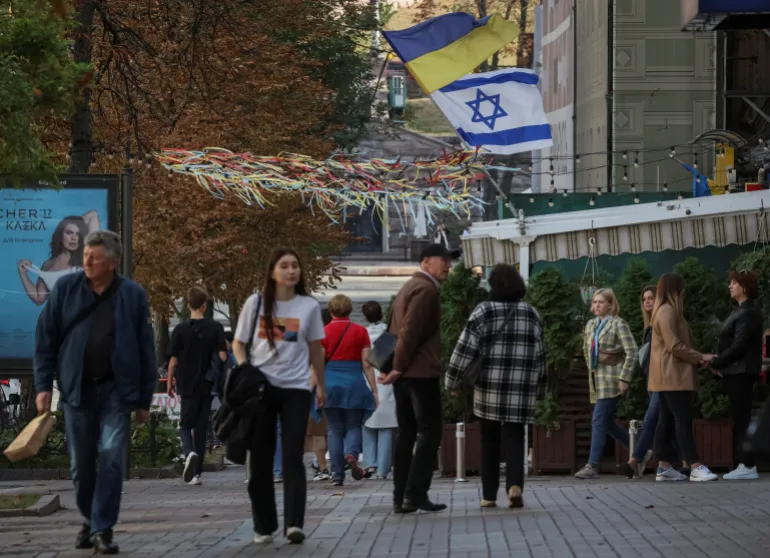
An Israeli flag flies next to a Ukrainian flag in central Kyiv, Ukraine, on October 14, 2023, a week after the war in Gaza began [Gleb Garanich/Reuters]
aljazeera.com
This photograph was taken one week after October 7, 2023. Two flags, side by side, above an ordinary Kyiv street. Nobody in the frame appears to notice.
The image does not require a caption to make its argument. It requires only a viewer who has been paying attention.
The same Western governments that elevated the Ukrainian flag as the defining symbol of the rules-based order — sovereignty inviolable, civilian life sacred, international law non-negotiable — simultaneously provided the weapons, intelligence, diplomatic cover, and UN Security Council vetoes that enabled the systematic destruction of Gaza. Not as a contradiction they were embarrassed by. As consistent policy. The same week this photograph was taken, the US was fast-tracking emergency military aid packages to both Israel and Ukraine. The same week, it was blocking ceasefire resolutions at the UN. The same week, its Secretary of State was in Tel Aviv affirming unconditional support while its President was invoking international law in speeches about Ukraine.
This is not hypocrisy in the ordinary sense — the gap between stated values and actual conduct. It is something more precise: the selective application of a legal and moral framework as a strategic instrument. International law is invoked when it serves Western geopolitical interests and suspended when it does not. The rules-based order is the order that benefits the rule-makers. Ukraine was admitted into its protections. Palestine was not. The difference is not moral. It is structural.
The ownership architecture makes this concrete. BlackRock — the same asset manager documented throughout this investigation as holding dominant stakes in the weapons manufacturers supplying Ukraine, and contracted to manage Ukraine's reconstruction framework — holds significant stakes in Elbit Systems, Israel's largest defence contractor, and in the US aerospace and defence companies supplying Israel's air campaign. Vanguard and State Street mirror those positions. The Big Three institutional investors profit from both theatres simultaneously. The weapons destroying Mariupol and the weapons destroying Gaza are held in the same portfolios, managed by the same firms, reported in the same quarterly earnings calls.
Francesca Albanese, UN Special Rapporteur on the occupied Palestinian territories, published her report on the structural conditions enabling what she termed genocide in Gaza in June 2025 — the same report that serves as a foundational source for TruthScout's ownership research. Her findings document the same capital networks, the same institutional shareholders, the same revolving door between corporate boards and government positions that this article has traced in the Ukraine context. The report is available at the United Nations. It has not altered Western policy by a single degree.
This is precisely what the Global South sees when it looks at the Ukrainian flag flying in Western cities. Not solidarity. Not principle. A symbol that has been consciously assigned moral weight in one context and consciously denied it in another — by the same governments, in the same week, with the same legal vocabulary. When India abstains on the UN Ukraine vote. When South Africa brings genocide proceedings against Israel at the ICJ. When the Sahel governments expel French troops and call out Western double standards by name. They are not being contrarian. They are applying the West's own stated principles consistently — and finding that the West will not.
The photograph from Kyiv is not an anomaly. It is the thesis.
The Equilibrium the System Prevents
The claim that a world free of Western structural dominance would be better is unprovable. Russia has its own imperial ambitions. China's Belt and Road architecture replicates many features of Western financial coercion. Neither state has a clean record on the sovereignty of smaller neighbours.
The operative claim is different and more defensible: the current order is specifically designed to prevent any alternative from developing long enough to be evaluated on its own terms. Every attempt at genuine non-alignment — from Lumumba to Sankara to the Sahel Alliance — is met with the full Western toolkit: coups, sanctions, media delegitimisation, financial strangulation. No alternative ever reaches maturity.
We cannot know what a post-hegemonic equilibrium would look like because the system is constructed to prevent the question from being answered.
Ukraine is the pivot point. It is where the formation politics of Western hegemony collided most catastrophically with its own limits. The system built a country into a particular political identity, deployed that identity as a strategic asset, and when the collision came, ensured the human cost fell almost entirely on the people who had been formed — not on the architects of their formation.
Part VII: The Epistemic Trap — Why the Flag Is Winning
How the Frame Closes
The flag-wavers are not stupid. They are operating within a framework specifically constructed to make structural analysis feel like moral failure:
Russia invaded → Russia is the aggressor → questioning causation = defending aggression → anyone who questions causation is a Russian agent or useful idiot.
Each step forecloses the next question. The frame is self-sealing. Evidence that challenges it gets classified as disinformation by definition. The person who presents the Nuland call is a Putin sympathiser. The person who cites Kennan is naive. The person who quotes Merkel's admission is spreading Russian propaganda — even though Merkel said it, in German, in a German newspaper, and it was not disputed.
Consider what this frame does to credentialed dissent. Jeffrey Sachs — Professor of Economics at Columbia University, former economic adviser to multiple heads of state, United Nations special adviser — spent three years trying to publish 700 words in the New York Times making the structural argument about Ukraine and NATO expansion. Not an op-ed. Not a feature. Seven hundred words. The Times would not publish even that. Not in print. Not online. The paper of record for American foreign policy discourse refused to run 700 words from one of the most credentialed economists in the world because the argument was, as Sachs put it, "not interesting apparently."
This is not editorial oversight. This is the frame operating at the institutional level. The same capital networks that profit from the war's continuation hold dominant stakes in the media companies that define the war's meaning for Western publics. Comcast, which owns CNBC and NBC News, shares its largest institutional shareholders with Lockheed Martin and Raytheon. Thomson Reuters — the wire service from which most Western news organisations source international reporting — has BlackRock as a major institutional shareholder. No editorial directive is needed. The structural incentive alignment is sufficient.
The Arrogance That Made It Inevitable
One dimension of this failure that rarely appears in structural analyses is the role of sheer miscalculation rooted in contempt. Sachs, who had direct access to senior US officials across two decades of this process, is unambiguous about what he heard in those rooms: "Russia's a pushover. We can do what we want. Who's going to stop us?"
This was not a fringe view. It was the operating assumption of the US foreign policy establishment from the mid-1990s onward. The assumption that Russia, weakened by economic collapse and political humiliation, lacked the capacity or the will to resist systematic encroachment on its declared security red lines. The assumption that Kennan was wrong, that Mearsheimer was naive, that the structural logic of great power security simply didn't apply to a degraded post-Soviet state.
That assumption was the final ingredient. The expansion was not just reckless because it provoked Russia. It was reckless because the people running it genuinely believed Russia would absorb it indefinitely. They were wrong. And the people paying for that miscalculation are Ukrainians.
What Actually Breaks Through
The path through the epistemic trap is not a better argument. Arguments can be dismissed. The path through is evidence that creates cognitive dissonance — something that does not fit the model and forces the model itself into question.
The Merkel admission. The Nuland call. The Baker cables. The Arakhamia statement. The Brzezinski blueprint. The Minsk confession confirmed independently by Merkel, Hollande, and Poroshenko. These are documented facts from Western officials, in Western publications, confirmed by Western governments. The frame has no mechanism to absorb them. Each one, placed in front of someone operating in good faith within the flag-waving framework, creates a moment of instability.
You cannot win a debate against a self-sealing frame. You can place evidence next to a person and wait.
Conclusion: The Right Question
There is a version of this article that ends with a call for peace negotiations. There is a version that ends with a condemnation of Russian conduct. Both are true. Both are beside the point.
The point is this: the war in Ukraine is not what it has been presented as. It is not a spontaneous act of fascist aggression against an innocent democracy. It is the terminal event of a thirty-year formation process — the collision of a systematic expansion project with the geopolitical reality it was always going to produce. That the collision has generated genuine heroism on the Ukrainian side, genuine suffering in Ukrainian cities, and genuine criminality in Russian conduct does not change what produced it.
Understanding what produced it is the precondition for understanding the world the conflict is reshaping: a world in which the Global South has watched the selective application of Western moral principles and drawn its conclusions; in which the dollar-based financial order is being actively challenged by states with the mass and the motivation to challenge it; in which the unipolar moment is ending — not because Russia is virtuous or China is trustworthy, but because the order those states are pushing against has produced enough harm across enough of the world's population to be structurally unsustainable.
The flag is not the wrong answer. It is the wrong question.
The right question is: who built this, who profits from it, and who pays?
The record answers all three.
Sources:
Baker "not one inch eastward" assurance and cascade of Western promises to Gorbachev, 1990 — declassified documents nsarchive.gwu.edu / primary Baker-Gorbachev memorandum of conversation nsarchive.gwu.edu
George Kennan, "A Fateful Error" — New York Times, 5 Feb. 1997 midcoastseniorcollege.org; further analysis comw.org
John Mearsheimer, "Why the Ukraine Crisis Is the West's Fault" — Foreign Affairs, Sept/Oct 2014 foreignaffairs.com
Putin, Munich Security Conference speech, 10 Feb. 2007 — Kremlin official transcript kremlin.ru; 2008 Bucharest NATO summit declaration nato.int
Zbigniew Brzezinski, The Grand Chessboard (1997) — full text cia.gov; analysis of Ukraine as geopolitical pivot antiwar.com
Putin, "On the Historical Unity of Russians and Ukrainians," 12 July 2021 — Kremlin kremlin.ru; critical reception and historical context huri.harvard.edu
Ian Traynor on US-funded political operations in Ukraine — The Guardian, 26 Nov. 2004 theguardian.com
OSCE/ODIHR Ukraine Presidential Election observation, Final Report 2010 osce.org
Nuland-Pyatt intercepted call — full transcript with BBC commentary globalresearch.ca; Washington Post authentication washingtonpost.com
OSCE Special Monitoring Mission to Ukraine — reports 2014–2022 osce.org; Amnesty International on Azov battalion and Donbas operations amnesty.org
UN Security Council Resolution 2202 — Minsk II endorsement (2015) un.org
Angela Merkel admits Minsk was designed to buy time — Die Zeit interview, 7 Dec. 2022, reported by tass.com; full analysis wsws.org
Russia's December 2021 draft security treaty — Russian Foreign Ministry mid.ru
Davyd Arakhamia on Boris Johnson and the collapse of Istanbul talks — Nov. 2023 dailysabah.com; Declassified UK analysis declassifieduk.org; academic review H-Diplo/RJISSF issforum.org
Seymour Hersh on Nord Stream pipeline sabotage — Substack, 8 Feb. 2023 seymourhersh.substack.com
BlackRock Ukraine reconstruction advisory contract, July 2022 blackrock.com
ICC arrest warrant for Vladimir Putin, ICC-01/22, 17 March 2023 icc-cpi.int
UN General Assembly vote ES-11/1 on Russia's invasion, 2 March 2022 undocs.org
Albanese, UN Special Rapporteur Report A/HRC/59/23, June 2025 — anatomy of genocide, structural conditions and named entities ohchr.org
BlackRock holdings in Elbit Systems and US defence contractors — SEC 13F filings sec.gov
South Africa v. Israel — ICJ Application instituting proceedings, 29 Dec. 2023 icj-cij.org
US Security Council vetoes on Gaza ceasefire resolutions — UN voting records research.un.org
🔍 This investigation was drafted with the assistance of AI tools under the editorial guidance of a human researcher. All claims are independently verified. Please read about our methodology here.
This photograph was taken one week after October 7, 2023. Two flags, side by side, above an ordinary Kyiv street. Nobody in the frame appears to notice.
The image does not require a caption to make its argument. It requires only a viewer who has been paying attention.
The same Western governments that elevated the Ukrainian flag as the defining symbol of the rules-based order — sovereignty inviolable, civilian life sacred, international law non-negotiable — simultaneously provided the weapons, intelligence, diplomatic cover, and UN Security Council vetoes that enabled the systematic destruction of Gaza. Not as a contradiction they were embarrassed by. As consistent policy. The same week this photograph was taken, the US was fast-tracking emergency military aid packages to both Israel and Ukraine. The same week, it was blocking ceasefire resolutions at the UN. The same week, its Secretary of State was in Tel Aviv affirming unconditional support while its President was invoking international law in speeches about Ukraine.
This is not hypocrisy in the ordinary sense — the gap between stated values and actual conduct. It is something more precise: the selective application of a legal and moral framework as a strategic instrument. International law is invoked when it serves Western geopolitical interests and suspended when it does not. The rules-based order is the order that benefits the rule-makers. Ukraine was admitted into its protections. Palestine was not. The difference is not moral. It is structural.
The ownership architecture makes this concrete. BlackRock — the same asset manager documented throughout this investigation as holding dominant stakes in the weapons manufacturers supplying Ukraine, and contracted to manage Ukraine's reconstruction framework — holds significant stakes in Elbit Systems, Israel's largest defence contractor, and in the US aerospace and defence companies supplying Israel's air campaign. Vanguard and State Street mirror those positions. The Big Three institutional investors profit from both theatres simultaneously. The weapons destroying Mariupol and the weapons destroying Gaza are held in the same portfolios, managed by the same firms, reported in the same quarterly earnings calls.
Francesca Albanese, UN Special Rapporteur on the occupied Palestinian territories, published her report on the structural conditions enabling what she termed genocide in Gaza in June 2025 — the same report that serves as a foundational source for TruthScout's ownership research. Her findings document the same capital networks, the same institutional shareholders, the same revolving door between corporate boards and government positions that this article has traced in the Ukraine context. The report is available at the United Nations. It has not altered Western policy by a single degree.
This is precisely what the Global South sees when it looks at the Ukrainian flag flying in Western cities. Not solidarity. Not principle. A symbol that has been consciously assigned moral weight in one context and consciously denied it in another — by the same governments, in the same week, with the same legal vocabulary. When India abstains on the UN Ukraine vote. When South Africa brings genocide proceedings against Israel at the ICJ. When the Sahel governments expel French troops and call out Western double standards by name. They are not being contrarian. They are applying the West's own stated principles consistently — and finding that the West will not.
The photograph from Kyiv is not an anomaly. It is the thesis.
The Equilibrium the System Prevents
The claim that a world free of Western structural dominance would be better is unprovable. Russia has its own imperial ambitions. China's Belt and Road architecture replicates many features of Western financial coercion. Neither state has a clean record on the sovereignty of smaller neighbours.
The operative claim is different and more defensible: the current order is specifically designed to prevent any alternative from developing long enough to be evaluated on its own terms. Every attempt at genuine non-alignment — from Lumumba to Sankara to the Sahel Alliance — is met with the full Western toolkit: coups, sanctions, media delegitimisation, financial strangulation. No alternative ever reaches maturity.
We cannot know what a post-hegemonic equilibrium would look like because the system is constructed to prevent the question from being answered.
Ukraine is the pivot point. It is where the formation politics of Western hegemony collided most catastrophically with its own limits. The system built a country into a particular political identity, deployed that identity as a strategic asset, and when the collision came, ensured the human cost fell almost entirely on the people who had been formed — not on the architects of their formation.
Part VII: The Epistemic Trap — Why the Flag Is Winning
How the Frame Closes
The flag-wavers are not stupid. They are operating within a framework specifically constructed to make structural analysis feel like moral failure:
Russia invaded → Russia is the aggressor → questioning causation = defending aggression → anyone who questions causation is a Russian agent or useful idiot.
Each step forecloses the next question. The frame is self-sealing. Evidence that challenges it gets classified as disinformation by definition. The person who presents the Nuland call is a Putin sympathiser. The person who cites Kennan is naive. The person who quotes Merkel's admission is spreading Russian propaganda — even though Merkel said it, in German, in a German newspaper, and it was not disputed.
Consider what this frame does to credentialed dissent. Jeffrey Sachs — Professor of Economics at Columbia University, former economic adviser to multiple heads of state, United Nations special adviser — spent three years trying to publish 700 words in the New York Times making the structural argument about Ukraine and NATO expansion. Not an op-ed. Not a feature. Seven hundred words. The Times would not publish even that. Not in print. Not online. The paper of record for American foreign policy discourse refused to run 700 words from one of the most credentialed economists in the world because the argument was, as Sachs put it, "not interesting apparently."
This is not editorial oversight. This is the frame operating at the institutional level. The same capital networks that profit from the war's continuation hold dominant stakes in the media companies that define the war's meaning for Western publics. Comcast, which owns CNBC and NBC News, shares its largest institutional shareholders with Lockheed Martin and Raytheon. Thomson Reuters — the wire service from which most Western news organisations source international reporting — has BlackRock as a major institutional shareholder. No editorial directive is needed. The structural incentive alignment is sufficient.
The Arrogance That Made It Inevitable
One dimension of this failure that rarely appears in structural analyses is the role of sheer miscalculation rooted in contempt. Sachs, who had direct access to senior US officials across two decades of this process, is unambiguous about what he heard in those rooms: "Russia's a pushover. We can do what we want. Who's going to stop us?"
This was not a fringe view. It was the operating assumption of the US foreign policy establishment from the mid-1990s onward. The assumption that Russia, weakened by economic collapse and political humiliation, lacked the capacity or the will to resist systematic encroachment on its declared security red lines. The assumption that Kennan was wrong, that Mearsheimer was naive, that the structural logic of great power security simply didn't apply to a degraded post-Soviet state.
That assumption was the final ingredient. The expansion was not just reckless because it provoked Russia. It was reckless because the people running it genuinely believed Russia would absorb it indefinitely. They were wrong. And the people paying for that miscalculation are Ukrainians.
What Actually Breaks Through
The path through the epistemic trap is not a better argument. Arguments can be dismissed. The path through is evidence that creates cognitive dissonance — something that does not fit the model and forces the model itself into question.
The Merkel admission. The Nuland call. The Baker cables. The Arakhamia statement. The Brzezinski blueprint. The Minsk confession confirmed independently by Merkel, Hollande, and Poroshenko. These are documented facts from Western officials, in Western publications, confirmed by Western governments. The frame has no mechanism to absorb them. Each one, placed in front of someone operating in good faith within the flag-waving framework, creates a moment of instability.
You cannot win a debate against a self-sealing frame. You can place evidence next to a person and wait.
Conclusion: The Right Question
There is a version of this article that ends with a call for peace negotiations. There is a version that ends with a condemnation of Russian conduct. Both are true. Both are beside the point.
The point is this: the war in Ukraine is not what it has been presented as. It is not a spontaneous act of fascist aggression against an innocent democracy. It is the terminal event of a thirty-year formation process — the collision of a systematic expansion project with the geopolitical reality it was always going to produce. That the collision has generated genuine heroism on the Ukrainian side, genuine suffering in Ukrainian cities, and genuine criminality in Russian conduct does not change what produced it.
Understanding what produced it is the precondition for understanding the world the conflict is reshaping: a world in which the Global South has watched the selective application of Western moral principles and drawn its conclusions; in which the dollar-based financial order is being actively challenged by states with the mass and the motivation to challenge it; in which the unipolar moment is ending — not because Russia is virtuous or China is trustworthy, but because the order those states are pushing against has produced enough harm across enough of the world's population to be structurally unsustainable.
The flag is not the wrong answer. It is the wrong question.
The right question is: who built this, who profits from it, and who pays?
The record answers all three.
Sources:
Baker "not one inch eastward" assurance and cascade of Western promises to Gorbachev, 1990 — declassified documents nsarchive.gwu.edu / primary Baker-Gorbachev memorandum of conversation nsarchive.gwu.edu
George Kennan, "A Fateful Error" — New York Times, 5 Feb. 1997 midcoastseniorcollege.org; further analysis comw.org
John Mearsheimer, "Why the Ukraine Crisis Is the West's Fault" — Foreign Affairs, Sept/Oct 2014 foreignaffairs.com
Putin, Munich Security Conference speech, 10 Feb. 2007 — Kremlin official transcript kremlin.ru; 2008 Bucharest NATO summit declaration nato.int
Zbigniew Brzezinski, The Grand Chessboard (1997) — full text cia.gov; analysis of Ukraine as geopolitical pivot antiwar.com
Putin, "On the Historical Unity of Russians and Ukrainians," 12 July 2021 — Kremlin kremlin.ru; critical reception and historical context huri.harvard.edu
Ian Traynor on US-funded political operations in Ukraine — The Guardian, 26 Nov. 2004 theguardian.com
OSCE/ODIHR Ukraine Presidential Election observation, Final Report 2010 osce.org
Nuland-Pyatt intercepted call — full transcript with BBC commentary globalresearch.ca; Washington Post authentication washingtonpost.com
OSCE Special Monitoring Mission to Ukraine — reports 2014–2022 osce.org; Amnesty International on Azov battalion and Donbas operations amnesty.org
UN Security Council Resolution 2202 — Minsk II endorsement (2015) un.org
Angela Merkel admits Minsk was designed to buy time — Die Zeit interview, 7 Dec. 2022, reported by tass.com; full analysis wsws.org
Russia's December 2021 draft security treaty — Russian Foreign Ministry mid.ru
Davyd Arakhamia on Boris Johnson and the collapse of Istanbul talks — Nov. 2023 dailysabah.com; Declassified UK analysis declassifieduk.org; academic review H-Diplo/RJISSF issforum.org
Seymour Hersh on Nord Stream pipeline sabotage — Substack, 8 Feb. 2023 seymourhersh.substack.com
BlackRock Ukraine reconstruction advisory contract, July 2022 blackrock.com
ICC arrest warrant for Vladimir Putin, ICC-01/22, 17 March 2023 icc-cpi.int
UN General Assembly vote ES-11/1 on Russia's invasion, 2 March 2022 undocs.org
Albanese, UN Special Rapporteur Report A/HRC/59/23, June 2025 — anatomy of genocide, structural conditions and named entities ohchr.org
BlackRock holdings in Elbit Systems and US defence contractors — SEC 13F filings sec.gov
South Africa v. Israel — ICJ Application instituting proceedings, 29 Dec. 2023 icj-cij.org
US Security Council vetoes on Gaza ceasefire resolutions — UN voting records research.un.org
🔍 This investigation was drafted with the assistance of AI tools under the editorial guidance of a human researcher. All claims are independently verified. Please read about our methodology here.
Want to join, contribute to our methods or verify a report?
Wield truth with us, in the fight for equality.
This project is open to contributors, collaborators, whistleblowers, and observers.
If you're a researcher, journalist, designer, or simply someone who refuses to believe the official story — there’s a place for you here.We’re not asking for your CV.
We’re asking for your eyes, your honesty, and your refusal to look away.
Wield truth with us, in the fight for equality.
This project is open to contributors, collaborators, whistleblowers, and observers.
If you're a researcher, journalist, designer, or simply someone who refuses to believe the official story — there’s a place for you here.We’re not asking for your CV.
We’re asking for your eyes, your honesty, and your refusal to look away.
Want to join, contribute to our methods or verify a report?
Want to join, contribute to our methods or verify a report?
Wield truth with us, in the fight for equality.
This project is open to contributors, collaborators, whistleblowers, and observers.
If you're a researcher, journalist, designer, or simply someone who refuses to believe the official story — there’s a place for you here.We’re not asking for your CV.
We’re asking for your eyes, your honesty, and your refusal to look away.
